


By the time people encounter subliminal audio seriously, most have already tried to change their lives through conscious effort alone. They have read the books, set goals, practiced affirmations, and attempted to “think positively.” Some progress may have occurred—but often inconsistently, and often with an undercurrent of internal resistance.
This experience raises a reasonable question: If conscious intention is not always enough, what role—if any—can subliminal influence play?
The answer is neither mystical nor mechanical. Subliminal audio does not replace effort, intention, or responsibility. Instead, it operates in a quieter space—supporting change by reducing internal friction and reinforcing alignment between what a person wants and how they habitually think.
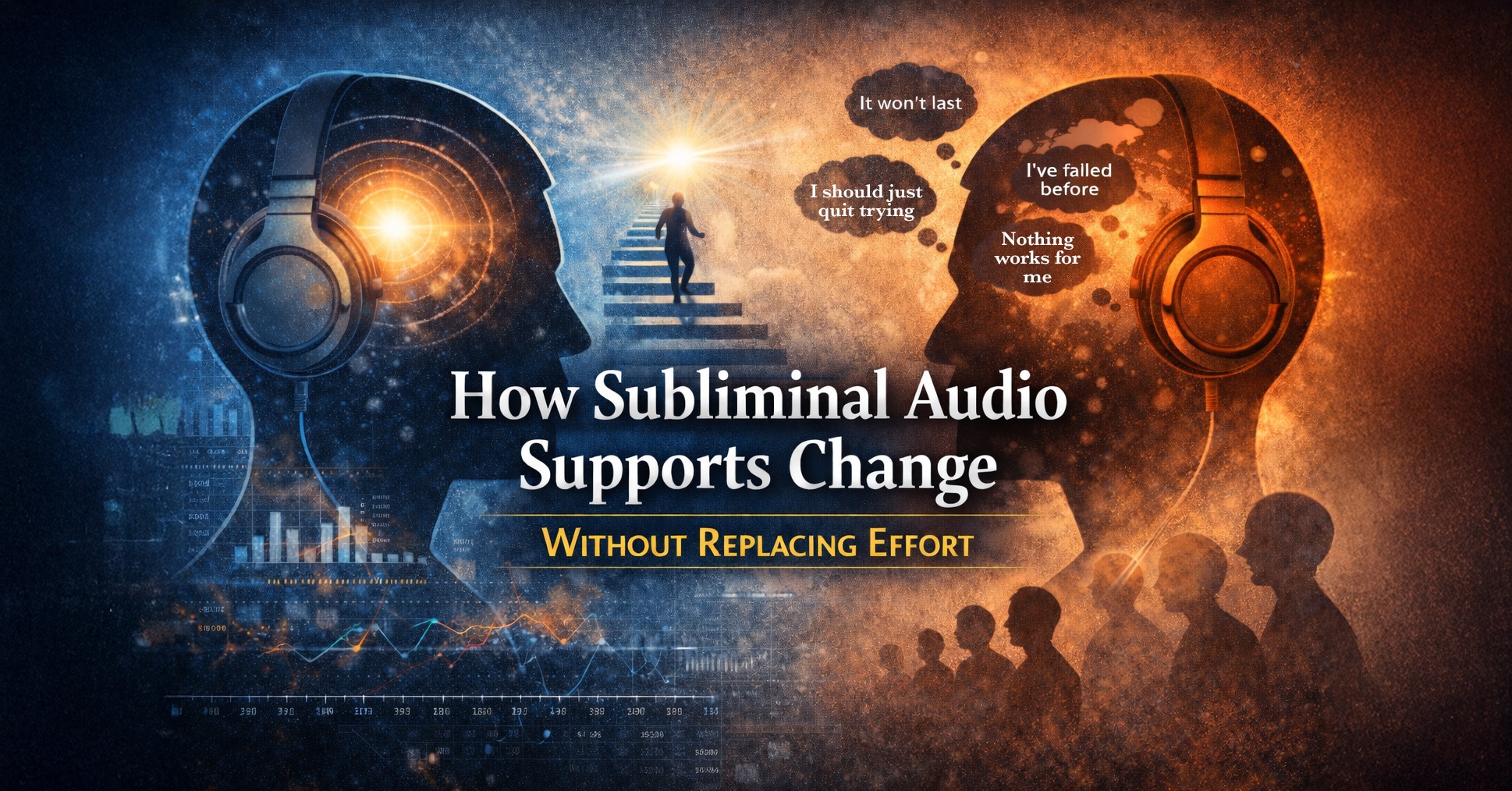
Conscious thought is powerful, but it is not the sole driver of behavior. Much of human cognition operates automatically: habits, emotional responses, self-talk, and expectation patterns function largely outside deliberate awareness.
This does not mean conscious effort is ineffective—it means it often competes with preexisting internal patterns. A person may consciously intend to change while simultaneously carrying automatic assumptions such as:
When conscious intention and automatic self-talk are misaligned, effort becomes exhausting. Progress stalls not because the goal is wrong, but because the internal system is divided.
Subliminal audio does not introduce new values or override judgment. Its role is far narrower and more specific.
Research suggests that subliminal priming can influence the accessibility of internal language patterns—the background self-talk that shapes expectation. Over time, this can make certain interpretations easier to access and others less dominant.
In practical terms, subliminal audio may help by:
This does not create motivation. It supports it.
It does not cause behavior. It influences the conditions under which behavior becomes easier or harder to sustain.
A useful way to understand subliminal audio is to view it as reinforcement rather than intervention.
Just as physical training is supported by rest, nutrition, and recovery, psychological change is supported by internal conditions that allow effort to take hold.
Subliminal audio operates at this supporting level.
Without conscious engagement, subliminal effects tend to fade.
Without behavior, expectation has nothing to shape.
Without intention, reinforcement has no direction.
When these elements work together—intention, effort, reinforcement—change becomes more sustainable and less effortful over time.
Expectation is a central mediator between thought and behavior. It influences how people interpret difficulty, how long they persist, and whether they view setbacks as signals to quit or adjust.
Subliminal priming does not manufacture optimism. What it can do is reduce the automatic dominance of limiting expectations, allowing alternative interpretations to become more available.
This shift is often subtle. But subtle shifts in expectation compound. They influence:
Change emerges not because effort disappears, but because resistance no longer consumes as much energy.
Because subliminal influence operates below conscious awareness, ethical clarity is essential.
Responsible use requires:
Subliminal audio should never be framed as a shortcut, a cure, or a substitute for agency. Its appropriate role is supportive, not directive.
When used ethically, subliminal techniques mirror processes already present in learning, habit formation, and emotional conditioning—processes that occur naturally throughout life.
Subliminal audio is best understood as one element within a broader system of change that includes:
It does not stand apart from these factors. It works alongside them.
When integrated thoughtfully, subliminal reinforcement can make growth feel less like a constant struggle and more like a gradual realignment—where effort is still required, but no longer perpetually resisted.
The appeal of subliminal audio has often been distorted by exaggerated promises and unrealistic expectations. But stripped of myth, what remains is something far more practical.
Subliminal influence does not bypass effort.
It supports it.
It does not replace choice.
It reinforces alignment.
Understood this way, subliminal audio becomes neither mysterious nor threatening. It becomes a modest, bounded tool—one that works quietly, ethically, and in service of conscious change.
And that is precisely where it belongs.