


Paraphrased, J. Krishnamurti said, “Choice is an illusion. Do I do this—do I do that—all of this is confusion. I can only choose when I’m confused. When I know clearly, there is no choice.” Thirty years ago, Benjamin Libet showed that there is activity in the subconscious within milliseconds before a conscious thought occurs. In other words, our so-called conscious thoughts are given us by our subconscious.

Fixers
People everywhere want to know how to improve their lives. Typically, they believe that if they had more money, more power, more success, and better relationships, then they would be happy. Because of such beliefs, the world is full of fixers. There is a motivational guru on every corner, and there is no shortage of people waiting to spend their time and money on learning the secrets to success. In a sense, I am no different; however, after more than thirty years of working with individuals in emotional distress, people seeking inner peace, athletes looking to win gold medals, sports organizations seeking to win championships, ordinary people trying to find a place in this world, and so on, I have learned this: The model is all wrong!
Stuff Happens
Imagine that you’re visiting New York City for the first time. You’re amazed at the skyline—all those immensely tall buildings. You visit a beautiful area of high-rise condominiums. These are truly luxurious condos, all with balconies suspended above the sidewalk. It’s a glorious day. The sun is out, and the slight breeze you feel is warm and comforting. The air is unusually fresh for any part of the world, and you’re simply walking, taking in the sights and sounds, and enjoying the day to the fullest. It’s New York, and you have heard stories about this city, but it’s light and bright and pleasant, and you walk on, thinking of all that you’ll tell your friends back home.
Suddenly, from the third-floor balcony above you, a flowerpot falls and slams onto your head. The pot is deflected onto the sidewalk and shatters. You’re not seriously hurt, but your head is hurting. You feel a bulge rapidly building into a rather large knot. Your scalp has a nasty abrasion that burns when you touch it, and on your hand is a small amount of blood. The suddenness and pain have raised your adrenaline level. That old fight/flight mechanism has kicked in, and the neurochemicals are flowing. Anger begins to rise. Now you have some choices.
What would you do?
Choices
Let’s think about that and explore some possibilities—possibilities given me over many years of lecturing. You could go up to that third-floor condo and shove you know what where. You might get there only to discover that the owner is a defensive linebacker for some professional football team and his biceps are larger than your waist. Then you might change your plan.
What else could you do? Some might think of this as an opportunity. “I’ll sue this fat cat. Anyone who puts a flowerpot too close to the edge of the balcony railing, just waiting to fall on someone, should be educated. What if it had fallen on a small child or a baby in a buggy passing under the balcony? Suing will be a quickie—they’ll settle out of court. That’ll teach them to be more careful in the future. Concussion and whiplash—I wonder what those are worth.”
What else could you do? Well, some might think the incident was a sign from the gods. It’s time to be metaphysical—after all, the blow might have delivered enlightenment. It might even be like one of those lightning strikes in which the person struck gains special metaphysical or parapsychological abilities. Like John Travolta in the movie Phenomena, such a person can do or solve almost anything. It’s like instantly acquiring the knowledge of the universe.
What else could you do?
What Else?
William James is credited with coining the term pragmatic. What is pragmatic? In our instance, it is simply responding to the stimuli in a manner that works for you. What would work for you? What if you picked up the flower off the hot sidewalk and took it to a florist for repotting? What if you selected a very nice pot, had the plant repotted, and then returned it to the owner with an explanation of why it was in a new pot? You could say something like this: “Your flower pot fell from your balcony and hit me on the head. The pot smashed against the sidewalk, so I took the beautiful flower to the florist and had it repotted for you. Here it is. I hope you like the new pot.”
Of all the things you might do, what do you think would make you feel the best? Of all the things you might do, what do you think would change those neurochemicals from fight/flight to growth and pleasure? Which choice would serve you best? The answer is obvious. But since it is so obvious, why wasn’t it recognized right away? Here is my point. In a scenario such as our flower pot story—and believe me we all have similar scenarios, like the person who cuts us off in traffic or pushes into line in front of those already queued up—why do we fail to see the obvious and instead choose the lesser? When the obvious should be so clear as to render the notion of choice unto the canvas of Krishnamurti, no choice, why is it so many of us fail even to recognize the alternative?
Choices and Illusions
In my book, Choices and Illusions, the reason so many fail together with the methods and means to correct this and all the other higher self alienating foibles most of us find ourselves perpetuating and repeating, are spelled out in a straight forward step by step way. If you never read the book, know this: it is always a matter of what you give and not what you take that defines the pivot point between success and failure.
As always, thanks for the read and I appreciate your feedback.
Eldon Taylor
–
Choices and Illusions
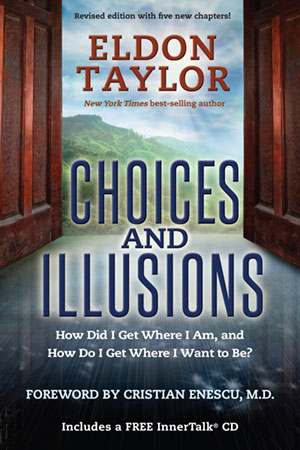
This article was excerpted from Eldon’s New York Times best-seller, Choices and Illusions.
Choices and Illusions tells the story of one man’s journey into the workings of the human mind and our reason for being. The adventure is every bit as exciting as the best scientific discoveries. Eldon Taylor’s approach is pragmatic, and his conclusions are inspirational and soul enhancing. Along the journey, you’ll hear fantastic stories of divine intervention, see why you think and do what you don’t wish to do, and understand the very clear message that it’s never too late to be happy and succeed, regardless of your past actions.
Eldon says: “Many believe that self-help and self-improvement is about rags to riches, failure to success, and so forth, when indeed it’s the beginning of a journey into self-discovery. Inside every human being is an eternal truth and a life purpose. Using our mind power is simply starting the engine on that path toward highest self-actualization.”
To get your copy, please click here.
P.S. If you enjoy these newsletters, please remember to share them with your friends and family. There are easy share buttons at the top of this newsletter. Please also be sure to friend Ravinder and Eldon on Facebook as they both love interacting with you all. You can also find them on Instagram (Ravinder, Eldon) and on Pinterest (Ravinder, Eldon), plus, you can read (and subscribe to) Eldon’s regular blog here.